Everything Dulcimer - Closing Down.
Dulcimer Resources:TABS/Books/websites/DVDs
I downloaded the articles on a thumb drive, just in case . It did not take long.
Joe
I downloaded the articles on a thumb drive, just in case . It did not take long.
Joe
What Dusty said but also on the Everything Dulcimer Facebook page
You might consider posting a "Wanted" listing in the For Sale Forum .
Thanks. I am searching the dulcimer community first.
You can contact David and order a dulcimer (or at least get on a waiting list) through his website: ww.davidbeede.com . I've never seen one of his dulcimers available in a store and used copies rarely come available.
Hello,
Does anyone have or know where a David Beede dulcimer can be found for sale? Thanks!
Lois, I'm not privy to any inside info, but I really believe that Bruce will make sure that *IF* the ED forums shut down, that at least the static content such as articles and Tab will be relocated and available online somewhere "in perpetuity" as he put it. Bruce has indicated that this is his intention, and we have no reason to doubt it.
Additionally, there seems to be a bunch of people making offers to take over running the ED forums. We don't know if/how that might work out, but it's another possible outcome. And it seems yet others are downloading the entire site onto home drives.
I feel we need to patiently wait and see what develops.
One of the things I love about FOTMD & the dulcimer is the frequent reminder that there's no ONE way to play. I find that also means I keep learning new things. Discussions here & articles at ED can be great resources that I might not currently need but want a while down the road in my dulcimer "journey". Yes, tab is a great resource, but what is the likelihood of anyone republishing articles.
I mentioned earlier a way to find the site once it is offline, but, if not re-posted on an online site, those articles won't be found in a search engine like Google. You will only know about those articles by searching the old ED site on the "Wayback Machine."
DRAT! Sure would love to see those articles move here or somewhere else in an active site.
Thanks to everyone who responded, I really appreciate the clarity of your instructions. I went to the 'jam' today with my two dulcimers, one tuned to D and the other to C. Since I don't have a capo yet, I managed to play along to about 90% of the music, using the fingering you provided. Many, many thanks! It was a lot of fun. I look forward to extending my versatility with a capo, but I now have a great start!
Susie, I'm sure the location of the tabs from ED will be well posted by many, no matter how the scenario plays out. 
Again... Bruce Ford says he will keep ED's Tab files available online for everyone to use, and no need for everyone to download all the Tabs.
When that is done, can you share the link to the location of the tabs?
The original post concerned playing along in a jam session with other stringed instruments in multiple keys. In that situation, retuning is rarely an option due to the noise and speed at which one tune flows into the next. In the quiet of one's own home, learning how to retune to play in different keys on a single dulcimer is an excellent skill to have. Using Dusty Turtle's chart, you will be relying primarily on the I, IV, and V chords.
In a jam session, however, the other musicians are not going to remain quiet and wait while you retune. You have to adjust to fit in with the other instruments. Utilizing a second dulcimer and a capo allows you to play in four different keys: D, G, C, and F. With the 6 1/2 fret, the Key of A is also possible.
D-A-A Tuning allows one to play in the Key of D from the nut, the Key of G from the capo at the 3rd fret, and the Key of A with the capo at the 4th fret and utilizing the 6 1/2 fret instead of the 6 fret.
C-G-G Tuning allows one to play in the Key of C from the nut, the Key of F from the capo at the 3rd fret, and the Key of G with the capo at the 4th fret and utilizing the 6 1/2 fret instead of the 6 fret.
@erna-schram, as you can see there are a few different approaches here. Mine is close to both Banjimer and Rob.
The most common keys in folk, bluegrass, or old timey jams are C, D, G, and A. If you practicetuning back and forth between DAA or DAd and CGG or CGC, then you will only need one dulcimer. For the key of G, capo at the third fret with your normal D tuning. For the key of A, capo at the fourth fret. Then all you have to know is how to transpose. What's nice about the capo is that you don't have to learn new chord shapes. You can continue to play the same chord shapes you already know. Then the only trick is knowing which chord to play. Perhaps this transposition chart will help.
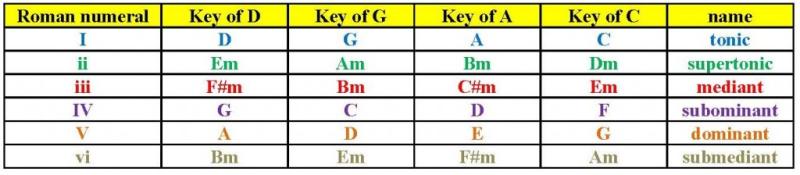
It should be obvious how to read this. If you are playing a song in the key of C and you are tuned CGG or CGC, then when the song requires a C chord, you use the fingering for your D chord. When the song requires a G chord, you use your fingering for an A chord. If the song is in the key of G, then tuned DAD or DAA, put the capo on the third fret. If the song requires a G chord, you use the fingering for a D chord. If the song requires a Bm, you use the fingering for an F#m. And so forth.
Personally, if I were bringing two dulcimers to a jam, I would tune one as a baritone to be able to get the keys of G and A and the other as a standard to get D and C. Then no capos are needed. But if you only bring one dulcimer and a capo, you can easily get the four most common keys.
And if you think a little bit, you can get the others as well. What if someone wants to play in the key of F to fit their voice? You can tune to C and capo at 3! If someone wants to play in Ab, you might first call them crazy, and then you could think: "If a capo at the fourth fret gives me the key of A when I'm tuned to D, if I tune to Db, the fourth fret will be Ab!" A little bit of creative thought will allow you to find most keys without having to re-learn different chord fingerings for each one.
Again... Bruce Ford says he will keep ED's Tab files available online for everyone to use, and no need for everyone to download all the Tabs.
I will give you a simple way to play in 4 different keys with two dulcimers and a capo.
First, tune the first dulcimer to D-A-A. Your basic chords in the Key of D are:
I Chord = D, 2-0-3 (where 2 represents the bass string fingered at 2nd fret, 0 represents the middle string left open, and 3 represents the melody strings fingered at 3rd fret)
IV Chord = G, 3-1-3 (where 3 represents the bass string fingered at the 3rd fret, 1 represents middle string fingered at the 1st fret, and the final 3 represents the melody strings fingered at the 3rd fret)
V Chord = A, 1-0-2 (where 1 represents the bass string fingered at the 1st fret, the 0 represents the middle string left open, and the 2 represents the melody strings fingered at the 2nd fret)
You can transpose the whole thing up to the Key of G by capoing at the 3rd fret and thinking of the capo as the new nut.
I Chord = G, 2-0-3 from capo (the actual frets fingered are 5-0-6)
IV Chord = C, 3-1-3 from capo (the actual frets fingered are 6-4-6)
V Chord = D, 1-0-2 from capo (the actual frets fingered are 4-0-5)
Second , tune the second dulcimer to C-G-G. The basic chords in the Key of C are:
I Chord = C
IV Chord = F
V Chord = G
The chord shapes remain the same as before: 2-0-3, 3-1-3, and 1-0-2.
Once again transpose up, by placing the capo at the 3rd fret. You can now play in the Key of F with the same chord shapes:
I Chord = F
IV chord = Bb
V Chord = C
In conclusion, the three chord shapes remain the same for all four keys: I chord = 2-0-3, IV Chord = 3-1-3, and V Chord = 1-0-2.
The capo is nothing more than a temporary nut. If you had a chromatic dulcimer you could capo at every fret on the dulcimer. Since most dulcimers do not have chromatic fretting, you just need to be sure that you have a comparable spacing of frets. Without the capo you have a large space, large space, and short space to the right of the nut. If you capo at the 3rd fret, you once again have a large space, large space, and small space to the right of the capo (temporary nut).
Finally, if you have a 6 1/2 fret you can place the capo at the 4th fret and in D-A-A tuning play in the Key of A. However, you must ignore the 6th fret when playing. You will have a large space from fret 4 to fret 5, a large space from fret 5 to fret 6 1/2, and a small space from fret 6 1/2 to fret 7.
I Chord = A
IV Chord = D
V Chord = E
Likewise, you can place the capo at the 4th fret in C-C-G tuning and play in the Key of G. Remember to ignore the 6th fret and use the 6 1/2 fret instead.
I Chord = G
IV Chord = C
V Chord = D
The easy part is that the basic chord shapes remain the same (2-0-3, 3-1-3, and 1-0-2) for all of the above. Just think of the capo as a movable nut that allows you to move the chord shapes up the fretboard to play in different keys.
So with two dulcimers, one tuned D-A-A and the other tuned C-G-G, you can play chords (or melodies for that matter) in five different keys: D, G, C, F, and A. These keys will handle nearly every key you will face on a regular basis.
2 dulcimers is a great way to go to jams. If you're in DAA then raise the bass string to E and your A melody & middle strings are in A mixolydian, EAA (Like DAd.) If you're in DAd then lower the A string to G and you're in G ionian, DGd (like DAA.) If there are some songs in C then take the DGd and capo on 3. This will get you started in jams.
I agree Dusty ... Heidi and Bob's music is wonderful. Lucky you that you got to hear them in such an intimate venue. Bob's cello together with Heidi's dulcimer is an incredible combination.
I can't wait to finish up some work so I can take the time to listen to the new podcast.
We had Heidi and Bob out here in Sacramento several months ago for a dulcimer workshop and house concert. We must have had about 30 guests for the concert, all packed into a private home sitting on rented chairs. I can't say we were comfortable, but the music transported us to a place of sweet harmony. I love that electric dulcimer/cello thing that Bob plays.
A Capo and a Reverse Capo can help you attain other tunings. Personally don't play chords, I play N&D or Fingerdance, and I re-tune, so others will explain who those tools can do better than I.
Most of the multi-instrument jams I've attended over the years go so quickly that there is no time to be flipping through pages trying to find the tune that has been called. What I do is listen the first time through and try to pick out a 3, 5 or more note "run" on the Melody string, and then play that run in the same time and tempo as everyone else. I'm sort of creating my own part, if you will, that fits in with what the others are playing.
Hi all! I'm a beginner player, and comfortable with reading and playing tabs. Recently sat in on a jam session with the other instruments and wanted to play along. Chording is new to me, but I can figure it out if I have a chart and if they play in the key I've tuned to. However, they switch from key to key! Looking for some clarity on the simplest way to join in. I've been reading up on tuning, capos, chording and droning. I have 2 dulcimers, so could tune each separately, perhaps one to D-A-A (or D-A-D) and the other to C-G-G, as I found a few chord charts that will help with the fingering. This way I can play in the key of D and the key of C. How to play in key of G or A, for example? I'd be grateful for any direction!
I can't wait to finish up some work so I can take the time to listen to the new podcast.
We had Heidi and Bob out here in Sacramento several months ago for a dulcimer workshop and house concert. We must have had about 30 guests for the concert, all packed into a private home sitting on rented chairs. I can't say we were comfortable, but the music transported us to a place of sweet harmony. I love that electric dulcimer/cello thing that Bob plays.
You da man Dusty, with yer superpower little jump drive! 

I'm still amazed that I could get all of FOTMD and ED on a little jump drive in my pocket. Wow! I feel so powerful! 
Yep -- back when a chip was a real chip!
Hearts of the Dulcimer Podcast - Episode 34
Heidi Muller and Bob Webb: Music with a Purpose

In this episode we feature the music and musical journey of life partners Heidi Muller and Bob Webb. Heidi and Bob are multi-instrumentalists who play original and traditional tunes. They blend each other’s influences that reach from the Pacific Northwest to the Appalachian Mountains.
Hearts of the Dulcimer Podcast can be found on most podcast apps.
Here's the link to Hearts of the Dulcimer on iTunes: http://bit.ly/hotdpodcast
Don't use a podcast app or iTunes? You can listen to all the podcast episodes directly on our website: http://dulcimuse.com/podcast
We also have a resource page for every episode, where you can find photos, videos, and song lists. Here's the resource page for this episode: http://dulcimuse.com/podcast/resource/034.html
Ken, wasn't that when they were making floppies out of stone tablets? 
Hi Indy!
To post an ad to sell an instrument, first click on link to "Forums" along the top row of site links on any page here. Then find the For Sale Forum at bottom of the list of forums . Once there, click the big "+" button to create your new thread. Be sure to read our guidelines for posting sale ads there. We do ask that you make a site donation of $5- if your ad results in a sale for you. :)
When I got involved with computers, a Megabyte was phenomenally large!!
I want to post a for sale listing, but can’t figure out how.
Hey I remember when 4 GB was considered HUGE... :D
ED is mostly a PHP forum, and text does not typically take up that much in terms of server size. Because of our multimedia content, FOTMD currently uses 23 GB of our 48 GB dedicated server. If I wanted to put fomtd on a smaller/cheaper 24 GB server, we wouldn't have room for any new members or content, and I'd have to remove a bunch of content and members to allow for normal growth.
Dusty - it's tough to say because I was at work when the process was finished. I also did not realize that, although I was using a very fast computer I was accidentally connected wirelessly. Therefore, my transfer speeds were very slow, and the time wouldn't really be representative anyway.
I can state, though, that with that slow connection I was averaging about 25 kb/s, and last time I looked I had downloaded 84% of the site in 13h, 20m (using no more than 4 active connections). A fast wired connection would dramatically reduce that time, and for someone just interested in the tunes, they total what, a little over 200MB? That wouldn't take much time at all.
Thanks, Brian. Just out of curiosity, how long did that download take?
I'm actually surprised. Less than 4 GB for the whole thing. Makes me wonder why servers have to be so big.
I promised to post final results, so here's what I have;
Total Website Size: 3.66GB
Number of files: 82,247
Number of Folders: 3,063
I know many people are interested in the tunes, specifically, so here's some information on that;
Tab PDFs: 1,397 files, 90.7 MB
Tab GIFs: 7 files, 268 KB
Tab JPGs: 15 files, 3.68 MB
Tab Word files: 6 files, 101 KB
Tab RTF Files: 2 files, 8 KB
MIDI files: 694 files, 2.43 MB
MP3s: 107 files, 123 MB
Lyrics Text files: 270 files, 716 KB
Thanks a million, Greg! I've traveled through Logan hundreds of times and Hide-A-Way Hills is in the Hocking Hills region, a rural area. I hope I'll be able to find time to do some investigation into Amburgeys in the area!
Wow that looks cool! Not to be too light hearted but I'm thinking I'm going to need to figure out a craft project for all my extraneous picks eventually! LOL
I sometimes go to Scrap in Portland. They have all sorts of donated art supplies. Last time I visited, they have a lot of piano parts. There were keys and some metal parts. The keys were not exotic woods, so we didn't buy any of it. We have an old portable pump organ in storage at our other place. I'd never thought about salvaging wood for a dulcimer, so I should take a second look at it.
I find my idea of my favorite pick changes from year to year. I have a whole box of favorite picks I've collected over time, and they are not all that similar... It's funny how our own playing preferences can change and evolve!
Bruce may well be making plans to house the Tabs and articles someplace online himself.
Folks, just a reminder about Strumelia's reminder. From what Bruce has said, it is likely that even if ED is shut down, the stable content (tabs, articles, etc) will likely still be available.
It's probably not a good look on stage, but it's better than losing control of a pick and having it fly into the audience!
I liked your entire response but I can definitely relate to the above. I found a fantastic new pick (I use the 1mm) and it addresses just about any pick foible you can imagine. Here are a couple of photos on my page: Pykmax
I discovered my favorite pick only recently. It's called Pykmax and is a revolution in guitar picks (IMHO). It's really hard to describe how it works but it basically is a mini-platform that holds a pick and is cradled in your hand. It's fantastic! They come in different pick sizes but I use the purple 1mm.
After 5 minutes of playing I no longer realized it was there except for the wonderful freedom from pick slips, turns, bounces, fly aways and any other picking mishap you can imagine. :D
Here's a couple of photos: Pykmax